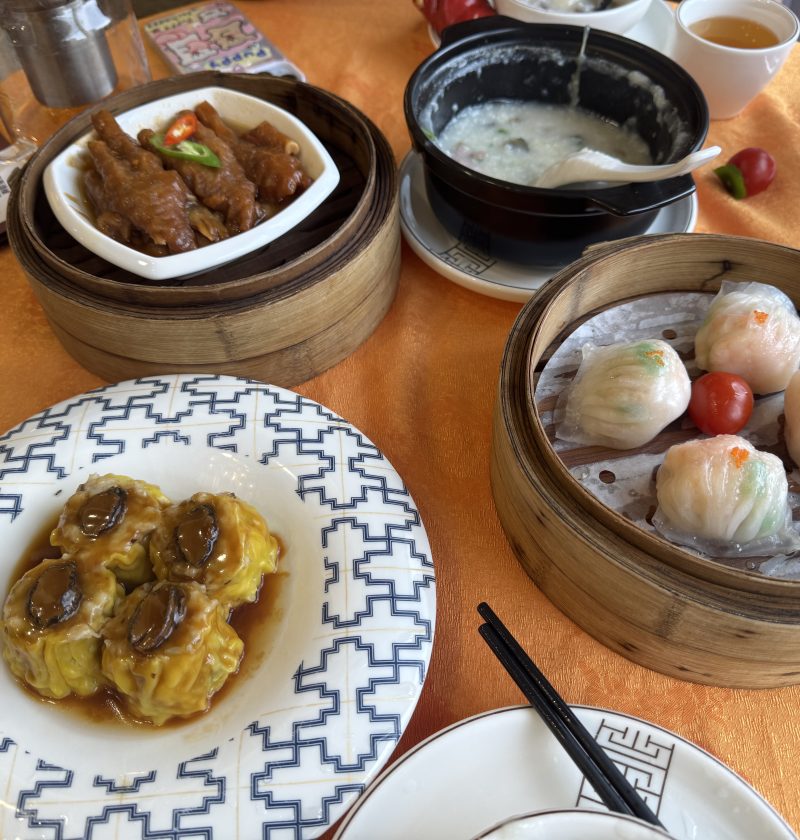
A friend invited me to yum cha, and I thought we were just going for tea. You know, a pot of hot tea, maybe a cookie on the side. Then we sat down at the restaurant, and the carts started coming out. Steamer baskets piled high with all kinds of things I couldn’t name. By the end of the meal, I’d eaten maybe ten different dishes — and I learned that “yum cha” in Cantonese means a whole lot more than just drinking tea.
What is Yum Cha?

So, what exactly is yum cha? In Cantonese, it literally means “drink tea.” But honestly? That’s like saying Thanksgiving is about the turkey. Technically true, but you’re missing the point.
Yum cha is really about the whole morning — gathering with family or friends, sitting around a table, and eating your way through plate after plate. Those steamer baskets show up on carts: shrimp dumplings, rice rolls, siu mai. The portions look small, but you end up sitting there for hours.
I got curious and looked up the history of teahouses. Turns out, it started in Guangzhou during the Qing Dynasty. Travelers on the Silk Road would stop at teahouses to rest, and the owners started offering small snacks alongside the tea. Eventually, the snacks became the main event. Now? Yum cha is a weekend tradition for Cantonese families. People show up early, grab a pot of tea, and don’t leave until they’ve worked through dozens of dishes — and caught up on everything happening in each other’s lives.
The Tea Strategy

Let’s be honest, “yum cha” literally translates to “drink tea,” but nobody wakes up early on a Sunday just for a cup of Pu’er. The tea is basically a culinary utility. It cuts through the grease of the pork belly, cleans your palate between dumplings, and gives you something to do with your hands while gossiping.
When the waiter rushes over, don’t panic over the tea menu. Most places just serve four basics. You’ve got Pu’er (Bo Lei), which looks and tastes like literal dirt but works miracles for digestion. Then there’s Sau Mei — a lighter, floral jasmine green tea. Hands-down my favorite. If you want something smoother, ask for Tie Guan Yin (a solid oolong), or just go with Chrysanthemum if you’re trying to avoid a caffeine crash at 11 AM.
Honestly, don’t overthink the flavor notes. The real test is the underground “table language.”
The first time someone poured tea for me, they didn’t wait for a “thank you.” Instead, they just casually tapped two fingers on the wooden table. I thought they were impatient, but turns out, that’s the universal sign for “cheers, mate.” Now I do it automatically without even looking up. Also, if your pot runs dry, don’t bother waving down the chaotic waiters. Just flip the teapot lid upside down or leave it propped open. It feels like you’re leaving a broken engine open, but trust me, someone will swoop in and refill it within two minutes.
Dim Sum: Small Bites, Big Flavors

Forget the tea — we’re here for the food. “Dim sum” means “touch the heart,” and the moment hot shrimp juice bursts out of a perfect har gow, you’ll get why. But since the menus look like giant tax documents, here are the heavy-hitters actually worth ordering:
must-eat
- Har Gow (shrimp dumplings) — The wrapper is supposed to be thin, translucent, a little chewy. If it falls apart when you pick it up? Bad sign. The shrimp inside should be snappy, not mushy.
- Siu Mai (pork and shrimp dumplings) — The ones with the yellow wrapper and orange stuff on top. Solid every time. Hard to mess these up.
- Char Siu Bao (bbq pork buns) — Fluffy white buns stuffed with sweet pork. There are baked versions too, but steamed is the classic. Be careful — the filling comes out lava-hot.
- Cheung Fun (rice rolls) — Silky, slippery noodles rolled around shrimp, beef, or just plain. They come drenched in sweet soy sauce. Get the shrimp one.
try it once
- Fung Zao (chicken feet) — Okay, I know how this sounds. Chicken feet? Really? But here’s the thing — you don’t eat the bones. You suck the skin off, which sounds gross but is actually delicious. Braised in black bean sauce. Super sticky from collagen. I was skeptical too. Now I order them every time.
- Lo Mai Gai (sticky rice in lotus leaf) — A little lotus leaf package filled with sticky rice, chicken, mushrooms, sometimes salted egg. It’s heavy. One is enough for two people.
skip it if you’re full
- Spring rolls — Fine, but you’ve had spring rolls before. Nothing special here.
- Egg tarts — More of a dessert. Flaky crust, creamy egg filling. Good, but save it for the end.
- Congee (rice porridge) — Comforting, but it’ll fill you up fast. Order it if someone’s sick or hungover.
One thing I learned the hard way: Don’t over-order. The portions look small, but you’ll be stuffed after five or six dishes. Start slow. You can always add more.

The Yum Cha Experience

So what’s it actually like inside one of these places?
Picture a giant, loud room. Round tables everywhere. Old ladies pushing carts loaded with steaming bamboo baskets, yelling out what they’ve got in Cantonese. You don’t know what half of it is. You just point at whatever looks good. They stamp your card, and the food keeps coming.
That’s the traditional way. Carts, chaos, no English. Honestly? It’s fun. But there’s a catch — the food might have been sitting there for a while. The har gow wrapper could be a little tough. The cheung fun might not be as silky.
A lot of places have switched to order sheets now. You check boxes on a piece of paper, hand it to the waiter, and everything comes fresh from the kitchen. Less chaotic. Less yelling. But the quality? Way better. The dumplings come out steaming hot, the wrapper still soft, the shrimp still snappy.
Some people miss the carts. I get it — there’s something about that chaotic energy. But for me? I’ll take the order sheet. I’d rather eat good food than chase a cart around.
One thing nobody warns you about: yum cha takes forever. You’re not in and out. You sit there for two or three hours, ordering round after round, drinking tea, talking about nothing. That’s the whole point. It’s not a meal. It’s a morning.
Families do this for birthdays. Friends do it to catch up after not seeing each other for weeks. Business people do it to… I don’t know, close deals? But mostly, it’s just an excuse to sit around a table with people you like and eat a bunch of small delicious things.
Where to Actually Go
You can find dim sum anywhere, but if you want the real deal, here is where to look:
Guangzhou: This is ground zero. Old-school places like Panxi Restaurant are basically living museums. You’ll be eating next to grandpas who have been sitting at the exact same table for forty years. It’s loud, it’s chaotic, and it’s perfect.
Hong Kong: HK took dim sum and turned it into a competitive sport. You can get Michelin-starred dumplings at Tim Ho Wan for the price of a coffee, or blow your savings at Lung King Heen. Either way, the precision here is insane.
Your Local Chinatown: If you’re in London, Sydney, or San Francisco, just use the golden rule: look through the window. If the room is packed with three generations of Chinese families talking over each other, you’re in the right place.
The Unwritten Rules
To survive your first meal without offending anyone, just keep these four habits in mind:
First, the finger tap. When someone pours your tea, tap two fingers on the table. It’s a silent “thanks.” Second, if the teapot runs dry, don’t hunt down a waiter—just leave the lid propped open. They’ll get the hint.
Most importantly, never stick your chopsticks straight down into a bowl of rice. It looks exactly like incense at a funeral, which is a massive vibe-killer. And finally, pace yourself. Don’t load up on the first three baskets of buns that show up. Yum cha is a marathon, not a sprint—give your stomach some breathing room.
The Verdict
At the end of the day, yum cha isn’t something you rush through to fuel up. It’s an excuse to slow down, kill a Sunday morning, and eat a ridiculous amount of dumplings with people you actually like.
So grab a few friends, find a noisy dining room, and just start pointing at things. And when the tea arrives, remember to give the table a quick tap. Sik fan (Let’s eat)!


